
Standard Queen Mattress, Fitted Sheet, and Flat Sheet Measurements
Queen size bed sheet dimensions depend on which piece you are measuring. A standard U.S. Queen mattress is approximately 60 inches wide and 80 inches long, according to the Better Sleep Council mattress guide. Most Queen fitted sheets are made for that sleeping surface, while flat sheets need extra width and length for draping and tucking.
The table below separates the measurements commonly used for Queen bedding. It also explains why a mattress, fitted sheet, and flat sheet can all carry a Queen label without sharing the same finished dimensions.
| Item | Typical Queen measurement | What the measurement describes |
|---|---|---|
| Standard Queen mattress | 60 × 80 inches | Width and length of the sleeping surface |
| Queen fitted sheet | Fits a 60 × 80-inch surface | Top dimensions plus a separate pocket depth |
| Queen flat sheet | Commonly about 90 × 102 inches | Total fabric width and length for drape and tucking |
| Pocket depth | Product-specific | The mattress height the fitted sheet is designed to cover |
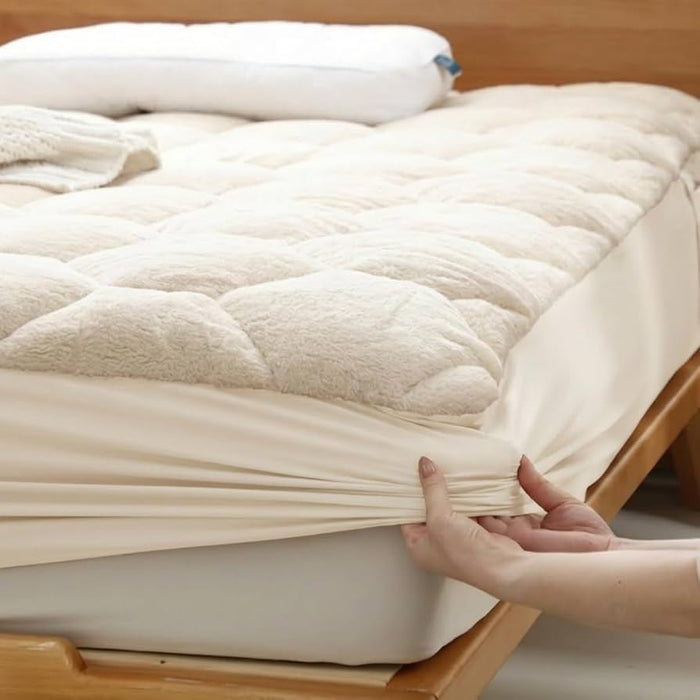
The 60 × 80-inch fitted size aligns with the mattress top, while its pocket extends down the sides and under the edges. A flat sheet is larger because it lies freely over the bed. Fitted sheets require closer size matching so all four corner seams align correctly, and our bedding size guide can help you compare the available dimensions.
Why Pocket Depth Matters for a Queen Fitted Sheet
Pocket depth tells you how much mattress height the fitted sheet can cover. Two Queen mattresses may both measure 60 × 80 inches, yet one may be 10 inches deep while a pillow-top model reaches 16 inches. The same fitted sheet may sit smoothly on one bed and fail to reach underneath the other.
Brands do not always define “standard,” “deep,” and “extra-deep” pockets in the same way. Use a stated range such as “fits mattresses 8 to 16 inches deep” instead of assuming every deep-pocket sheet fits the same height.
A shallow pocket may stop partway down the mattress side or barely tuck beneath the edge. Pulling it over the final corner increases seam tension and can loosen another corner. A pocket that is much too deep may leave extra fabric along the sides or sleeping surface.
The pocket measurement may describe the fitted corner, while the supported mattress range tells you what the finished sheet can cover. When both appear, use the fit range to decide whether the sheet matches your bed.

How to Measure a Queen Mattress for a Fitted Sheet
Measure the bed in its normal sleep setup. Keep every topper, pad, and protector beneath the fitted sheet, but remove blankets and other upper layers.
- Measure the width. Run a tape measure across the widest part from edge to edge. A standard Queen should be close to 60 inches.
- Measure the length. Measure from the outer edge at the head to the outer edge at the foot. It should be close to 80 inches.
- Measure the total depth. Lay a rigid straight edge across the top so it extends past the side. Measure vertically from the mattress bottom to its underside.
- Check the highest area. Pillow tops and foam toppers may rise unevenly, so measure several points without pressing down. Use the largest result.
Do not include the foundation, box spring, or bed frame. An 11-inch mattress with a 3-inch topper and padded protector may reach 14 or 15 inches, so measure the complete stack rather than the mattress alone.
The Good Housekeeping Institute’s fit advice also recommends measuring with toppers and pads installed. It adds that correct corner-seam alignment helps prevent other corners from pulling loose.
How to Match Your Measurements to the Right Fitted Sheet
First, match the measured width and length with the sheet size. A standard Queen should correspond to a fitted surface of about 60 × 80 inches. A difference of several inches may indicate an RV Queen, Olympic Queen, or another variation.
Next, compare the largest depth measurement with the stated fit range. A 14-inch bed needs a sheet that clearly supports at least 14 inches. When the measurement is close to the maximum, all-around elastic and enough fabric to tuck underneath become especially helpful.
A pillow-top mattress combined with a thick topper may measure close to 18 inches, making a deeper design more suitable. For this type of setup, the Queen fitted sheet in Luxe Bamboo Viscose Sheet Set measures 60 × 80 inches with an 18-inch pocket. Its 360° all-round elastic and reinforced corner straps help secure the sheet around mattresses up to 18 inches thick.
Before ordering, confirm the mattress width, length, total assembled depth, and the product’s stated fit range. Then review the elastic and corner design if your current fitted sheets frequently move during sleep.
Why a Queen Fitted Sheet May Still Fit Poorly
Correct measurements solve many fit problems, but installation and wear also affect how the sheet performs. If the dimensions match and the corners still move, check the following issues.
- The sheet is turned the wrong way. The 80-inch sides should run from the head to the foot. Rotating the sheet can make the final corners unusually tight.
- The corner seams are misaligned. A misplaced seam pulls the sheet diagonally and strains the opposite side. Align all four seams before tucking the elastic underneath.
- The elastic has weakened. Repeated stretching and high dryer heat can reduce elastic recovery. Follow the care label and replace a sheet that no longer grips securely.
- Excess fabric is trapped on top. Smooth the sheet from the center toward the sides after placing all four corners. Guide loose fabric under the mattress instead of leaving it gathered above.
Start with orientation and seam alignment because both are easy to correct. If the sheet remains loose, examine the elastic and confirm that the pocket range still matches the bed.
Measure Your Queen Bed Before Buying New Sheets
A secure Queen-sheet fit starts with three measurements: width, length, and total assembled depth. Match the first two numbers with a 60 × 80-inch Queen surface, then compare the depth with the product’s supported range. Checking these details before buying makes the sheet easier to install and helps the corners remain smooth and secure throughout the night.

FAQs
Q1. Should pocket depth be the same as mattress depth?
Use the supported mattress range instead of matching the two numbers exactly. Confirm that your assembled bed falls within the stated range.
Q2. Can an 18-inch pocket fit a 12-inch Queen mattress?
It may fit if the elastic secures the extra fabric beneath the mattress. Check the minimum and maximum supported depths because a tall pocket can feel loose on a lower-profile bed.
Q3. Can a King fitted sheet work on a Queen mattress?
A King fitted sheet is much wider and will usually leave loose fabric across a Queen bed. Corner straps cannot fully correct the difference, so use a Queen-specific sheet.
Q4. Is an RV Queen the same size as a standard Queen?
Not always. Many RV Queens are shorter than 80 inches, and measurements vary. Check the actual width, length, and depth before ordering.
Q5. Can corner straps fix a fitted sheet with the wrong pocket depth?
Corner straps can improve grip when the sheet is already within its fit range. They cannot add fabric to a shallow pocket or remove all the excess from one that is much too deep.